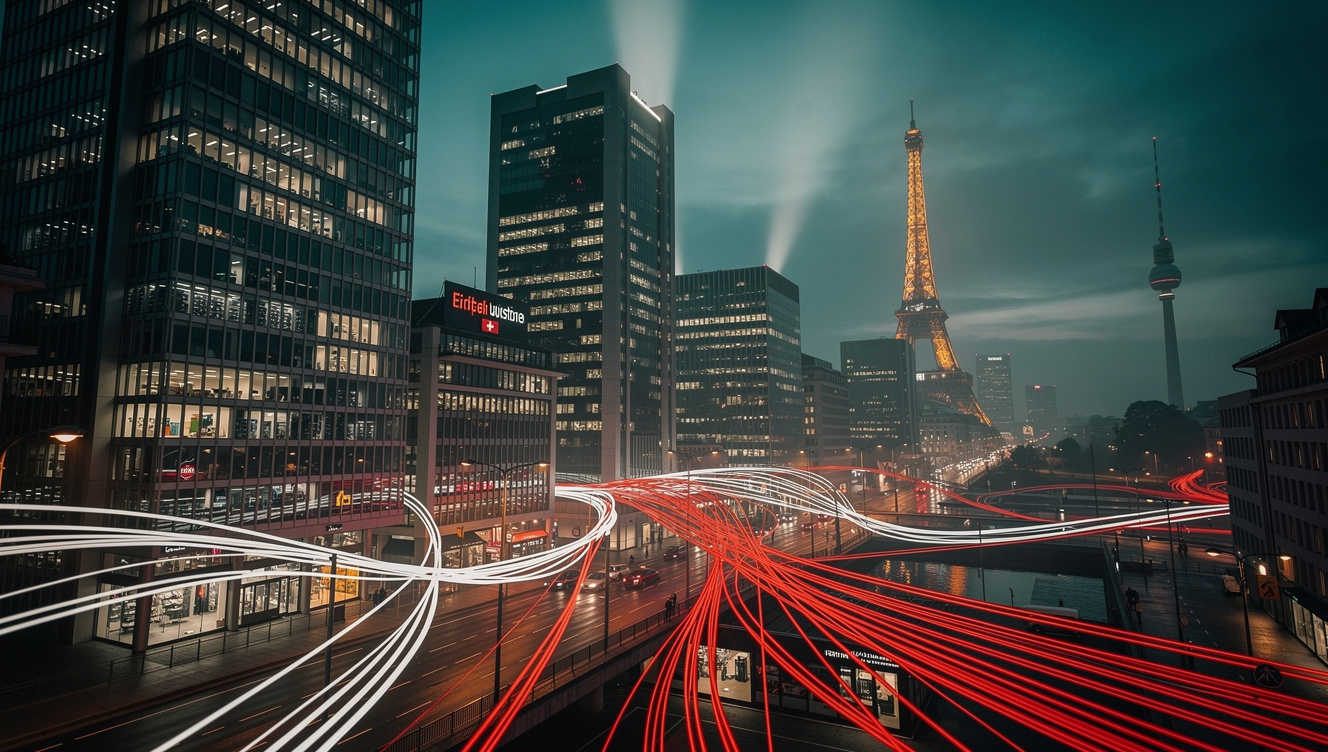
For the last decade, the conversation about Europe’s top tech hub has been a two-horse race: Berlin’s raw creative energy versus Paris’s government-backed startup machine. But while the world was watching them, a quiet revolution was happening in the Alps.
By 2026, the data suggests that the most dynamic, valuable, and impactful tech ecosystem in Europe won’t be on the Spree or the Seine, but on the shores of Lake Zurich and Lake Geneva.
The Switzerland tech scene is no longer just a “hidden gem.” It’s a powerhouse systematically outperforming its larger neighbors on the metrics that matter most: deep-tech investment, elite talent density, regulatory stability, and meaningful AI adoption. This isn’t about hype; it’s about fundamental, structural advantages that are creating a sustainable, high-value ecosystem. We’ll break down the four pillars driving this shift and show why Zurich and Lausanne are the new capitals of European tech.
Berlin built its reputation on a low-cost-of-living, B2C startups, and a vibrant creative class. Paris leveraged massive state investment and Station F to create an ecosystem at scale. Both models were successful, but they are showing signs of strain.
Berlin now faces rising costs and a B2C market saturated with delivery apps and e-commerce clones. Paris, while impressive, can feel top-down and bureaucratic. Both are struggling with the immense challenge of transitioning from scaling consumer apps to building foundational “deep tech” companies that will define the next 20 years.
Switzerland, by contrast, has been building this deep-tech foundation for decades. Its ecosystem is not a product of recent hype but the result of a long-term strategy centered on world-class education and a focus on solving difficult engineering and scientific problems.
Pillar 1: The Unmatched Flood of Deep Tech Capital
Money talks, and in Switzerland, it’s speaking the language of deep tech. While overall venture funding in Europe has cooled, Swiss investment in complex sectors like biotech, climate tech, quantum computing, and robotics is accelerating.
Per-Capita Investment That Dwarfs the Competition
The raw numbers are staggering. The Swiss Venture Capital Report revealed that per-capita VC funding in Switzerland hit an all-time high of €950. This figure absolutely dwarfs Germany’s €480 and France’s €510.
This isn’t just about more money; it’s about smarter money. Swiss family offices and institutional investors have a long history with the pharmaceutical and precision engineering industries. They are comfortable with long-term R&D cycles and understand the patient capital required to bring a scientific breakthrough from the lab to the market.
Climeworks (Zurich): A global leader in direct-air carbon capture.
SonarSource (Geneva): A foundational tool for code quality and security, used by millions of developers.
MindMaze (Lausanne): A neurotechnology company building the future of brain-computer interfaces.
These are not food delivery services. They are capital-intensive companies solving fundamental global challenges. This focus attracts a different caliber of investor and engineer, creating a virtuous cycle of ambition and execution.
Pillar 2: The Talent Engine of ETH Zurich and EPFL
An ecosystem is only as good as its talent. This is Switzerland’s undisputed trump card.
More Than Universities, They Are Unicorn Factories
ETH Zurich and EPFL are consistently ranked among the top 10 engineering universities in the world, often outranking every other institution in continental Europe.
ETH Zurich is an AI and robotics powerhouse, with deep ties to Google’s largest engineering office outside the US, located just a few kilometers away. It has produced over 500 spin-off companies.
EPFL is a center of excellence in life sciences, neurotechnology, and material science, anchoring the vibrant “Health Valley” that stretches from Geneva to Lausanne.
These institutions are not ivory towers. They have aggressive technology transfer programs designed to turn doctoral theses into venture-backed companies.
Winning the Global War for Talent
While Berlin and Paris attract young creatives, Switzerland attracts elite, experienced engineers, PhDs, and product leaders. Why?
Highest Tech Salaries in Europe: A senior software engineer in Zurich can command a salary 50-70% higher than their counterpart in Berlin.
Unbeatable Quality of Life: High salaries, political stability, safety, and unparalleled access to nature create a compelling package for mid-career professionals with families.
A Global Hub: Over 25% of the Swiss population are foreign nationals. Its cities are incredibly international, making for a soft landing for global talent.
Switzerland is experiencing a “brain gain” of the world’s best technical minds while other hubs fight to retain them.
Pillar 3: “Boring” Is the New Brilliant: The Regulatory Advantage
In a world of geopolitical instability and regulatory whiplash, Switzerland’s legendary predictability has become a powerful competitive advantage.
Stability in a World of Chaos
Founders and investors prize certainty. The Swiss legal and political framework is famously stable. Tax laws are consistent, corporate governance is clear, and the government takes a pragmatic, pro-innovation stance. Coupled with Switzerland’s strict nLPD data privacy laws, this creates a safe haven that contrasts sharply with the shifting political winds and complex labor laws across the border.
The canton of Zug, just south of Zurich, proactively created a clear legal framework for cryptocurrencies and blockchain companies years before other nations. This created “Crypto Valley,” the world’s most mature blockchain hub. This is the Swiss model in action: identify a new technology, consult with experts, and create clear, business-friendly rules. They are now applying this same playbook to AI and quantum computing.
Pillar 4: The Quiet Dominance in Applied AI
While Paris makes headlines with AI “moonshots” and Germany hosts large research conferences, Switzerland is quietly leading in the application of AI to high-value industries.
The Swiss AI Lab IDSIA is one of the world’s oldest and most respected deep learning research centers. More importantly, the knowledge from institutions like IDSIA, ETH, and EPFL is being directly embedded into the nation’s core industries:
Pharma & Biotech: Using AI for drug discovery (Roche, Novartis).
Robotics: Advanced industrial automation and autonomous systems.
This practical, industry-integrated approach means AI is creating real economic value today, not just academic papers.
Head-to-Head: Switzerland vs. Germany & France by the Numbers
When you strip away the hype, the data paints a clear picture.
Metric
Switzerland
Germany
France
VC Funding (per capita)
€950
€480
€510
Global Top 20 Universities
2 (ETH, EPFL)
1 (TUM)
1 (PSL)
Regulatory Stability
Very High
Medium
Medium
Deep Tech Unicorns
High Concentration
Medium
Medium-High
English Proficiency
Very High
High
Medium
The Twin Titans: Zurich’s FinTech Power and Lausanne’s Deep Tech Soul
The Swiss tech scene is not monolithic. It is defined by two complementary hubs.
Zurich
The financial capital is now a FinTech and AI powerhouse. Home to Google, Apple, and Amazon engineering offices, it has a deep pool of software talent. It’s the pragmatic, corporate-facing engine of the ecosystem.
Lausanne
Anchored by EPFL, this is the scientific and deep-tech heartland. The EPFL Innovation Park hosts hundreds of startups in areas like biotech, robotics, and neurotech. It’s the R&D lab of the ecosystem.
This dual-hub structure provides both commercial power and a pipeline of future-defining innovation.
The 2026 Outlook: Why the Momentum is Accelerating
The forces driving Switzerland’s rise are compounding. Every deep-tech unicorn that exits creates a new generation of angel investors and experienced founders. Every elite AI researcher who moves to Zurich for a job at Google raises the talent bar for everyone.
While Berlin and Paris are great cities, they are competing on a 2018 model of tech ecosystem development. The Switzerland tech scene is built for the challenges of the late 2020s: a world that needs fewer social media apps and more solutions to fundamental problems in climate, health, and computing.
Frequently Asked Questions about the Swiss Tech Scene
Is Switzerland too expensive for a startup?
The cost of living and salaries are high, but this is offset by higher valuations, greater access to deep-pocketed investors, and the immense productivity of elite talent. It’s a high-cost, high-output model.
Which city is better for tech, Zurich or Lausanne?
It depends on your sector. Choose Zurich for FinTech, enterprise software, and AI applications. Choose Lausanne for life sciences, med-tech, robotics, and fundamental R&D-driven companies.
How does the Swiss tech scene compare to London?
London remains Europe’s largest hub by sheer volume. However, Switzerland competes on quality, not quantity. It has a higher density of PhD-level talent and a stronger focus on deep tech and B2B, making it a different but equally potent ecosystem.
Is it difficult for foreigners to work in Swiss tech?
For highly skilled workers, particularly from the EU/EFTA, the process is streamlined. Non-EU talent can secure visas if sponsored by a company, and the demand for elite engineers and scientists is very high, making companies willing to handle the process.
The Alpine Tiger Has Awakened
The narrative of European tech is being rewritten. The future belongs to ecosystems that can fuse world-class scientific research with patient, intelligent capital and attract the absolute best global talent.
By 2026, it will be impossible to ignore the fact that the center of gravity has shifted south, to the quiet, efficient, and relentlessly innovative hubs of Zurich and Lausanne. The Alpine Tiger has awakened, and it’s ready to lead.